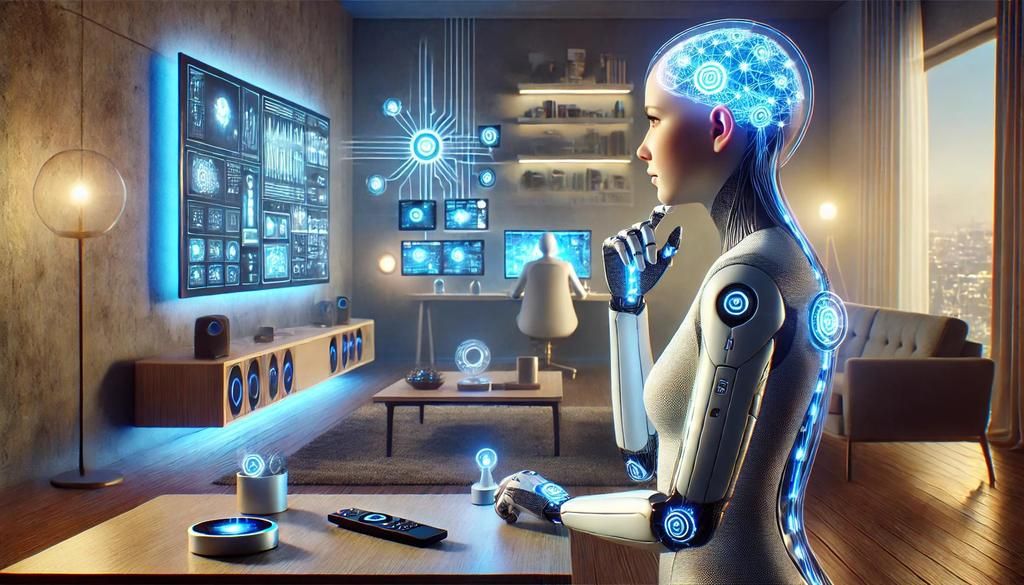
For the past few years, the world has been mesmerized by the meteoric rise of Artificial Intelligence. From conversational agents that can write poetry to algorithms that can design proteins, AI has firmly established itself as the foundational technology of our time—akin to the advent of the internet or electricity. But as AI becomes increasingly integrated into the fabric of our digital lives, the inevitable question arises: what is the next great technological leap?
If AI is the new engine of progress, the next frontier will be defined by how we interface with it. The 2030s will be a battleground for a new paradigm of human-computer interaction, and two primary contenders are emerging from the labs and entering the public consciousness: Spatial Computing and Brain-Computer Interfaces (BCIs). One promises to reshape our perception of reality, while the other seeks to merge our minds with machines. Which of these revolutionary technologies will define the next decade?
The Case for Spatial Computing: The Imminent Reality
Spatial Computing is the concept of blending digital information and media with the physical world, creating a single, interactive reality. It is the evolution of everything from desktop GUIs to mobile touchscreens, moving computation from flat screens into the three-dimensional space we inhabit.
Where We Are Today (2025): The seeds of the spatial era have already been sown. Apple’s Vision Pro, despite its high cost, demonstrated a compelling vision for a polished, high-fidelity spatial operating system. Meta’s Quest line continues to democratize virtual and mixed reality, building a vast user base. In enterprise, platforms for remote collaboration, 3D design, and field service assistance are already proving their value. We are currently in the “brick phone” era of spatial computing—the hardware is a bit heavy, the batteries are a bit short, but the potential is undeniable.
The Path Through the 2030s: The trajectory for Spatial Computing is an evolutionary one, making it a highly probable candidate to define the decade. The path forward includes:
- Hardware Maturation: By the early 2030s, we can expect devices to become what today’s headsets aspire to be: lightweight, all-day-wearable glasses with wide fields of view and long-lasting batteries. The technological hurdles are significant but are problems of engineering, not fundamental science.
- The AI Synergy: This is the crucial link. Spatial Computing will be the face of ambient AI. An AI assistant won’t just be a voice; it will be able to place a virtual arrow on the street to guide you, bring up a virtual screen with information about a product you’re looking at, or translate a foreign language sign in real-time right before your eyes. AI provides the context and content; spatial hardware provides the display.
- The Killer Applications: Beyond gaming, the killer apps will be profoundly practical. Architects will walk through their blueprints on a construction site. Medical students will perform dissections on virtual bodies in their dorm rooms. An expert engineer in Chennai will be able to guide a technician’s hands in a factory in Germany, seeing what they see and overlaying instructions onto their vision.
Spatial Computing is the logical next step. It doesn’t require us to change our fundamental biology; it changes our environment. It’s the more predictable, tangible, and, therefore, the more likely platform to achieve mass adoption and define the technological landscape of the 2030s.
The Case for Brain-Computer Interfaces: The Revolutionary Leap
If Spatial Computing is about changing our world, Brain-Computer Interfaces are about changing ourselves. A BCI is a direct communication pathway between the brain’s electrical activity and an external device, allowing a user to control computers, prosthetics, or other electronics with thought alone.
Where We Are Today (2025): The world of BCIs is currently one of breathtaking breakthroughs and immense limitations. We have seen companies like Neuralink successfully implant devices in human subjects, allowing paralyzed individuals to control a cursor with their mind—a medical miracle. Non-invasive technologies using EEG caps are helping people with focus and meditation. However, the field is still in its infancy. Invasive BCIs require high-risk brain surgery, while non-invasive BCIs suffer from a low signal-to-noise ratio, making them imprecise for complex tasks.
The Path Through the 2030s: The journey for BCIs is far more revolutionary and fraught with challenges:
- The Invasive/Non-Invasive Divide: This is the core challenge. Invasive BCIs offer high bandwidth but will likely remain confined to critical medical applications throughout the 2030s due to immense safety, ethical, and regulatory hurdles. The idea of undergoing elective brain surgery for a consumer device will not be mainstream. Non-invasive BCIs are safer but may struggle to move beyond simple commands (“on/off,” “select”) to the high-fidelity input needed for complex work.
- The Ethical Minefield: BCIs open a Pandora’s box of ethical dilemmas that society is not yet equipped to handle. What is the nature of “thought privacy” when a corporation can read your neural signals? Could this technology create a new societal divide between the cognitively enhanced and the unenhanced? What happens when a BCI is hacked? These questions must be answered before any widespread adoption.
- The Ultimate Killer App: Unlike a new phone, the “killer app” for BCI is a new mode of being—silent, instantaneous communication with AI and other humans; downloading skills; controlling your environment with a thought. This is a far more profound, and distant, promise.
BCIs represent a quantum leap. While they will undoubtedly produce incredible medical breakthroughs in the 2030s, their path to becoming a defining consumer technology is likely a post-2040 project.
Conclusion: A Symbiotic Future, Not a Simple Victor
The question of whether Spatial Computing or BCIs will define the 2030s is not a zero-sum game. The most likely outcome is that they will form a symbiotic relationship, with one leading the other.
The 2030s will be the Decade of Spatial Computing. It will become the primary interactive platform, moving us beyond handheld screens. It will be the canvas upon which AI paints our new reality.
During this time, BCIs will be the critical supporting act, making monumental strides in medicine and laying the groundwork for the future. Towards the end of the decade, we can expect to see the first consumer-grade, non-invasive BCIs emerge not as a standalone platform, but as the ultimate accessory for Spatial Computing—a “hands-free” and “voice-free” input method. Imagine looking at a virtual object in your spatial glasses and simply thinking to select it, or silently formulating a query for your AI assistant.
AI is the engine. Spatial Computing is the vehicle that will take us through the 2030s. And the BCI is the radical, new navigation system that will be perfected on this journey, ready to guide us into the frontiers of the 2040s and beyond.